
Table of contents
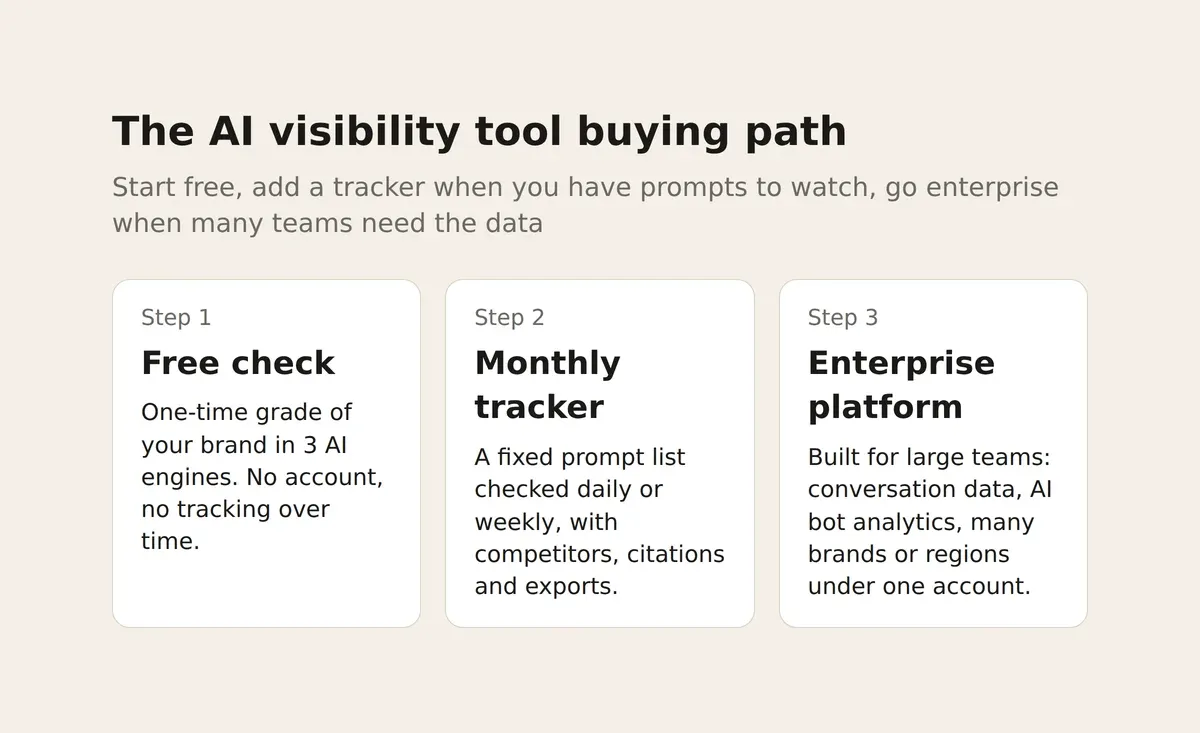
The best AI visibility tools in Nov 2026 are HubSpot AI Search Grader, SE Ranking, Otterly.AI, Peec AI, Rankscale, Semrush AI Visibility, Ahrefs Brand Radar, Scrunch and Profound, ordered from a free check to an enterprise platform. More than 4,000 brands and agencies already track their AI search presence in Peec AI alone, so the open question is which tool fits your budget.[1]
This guide covers the 9 picks, what an AI visibility tool is, what it should track, what AI visibility tools cost, how to pick one, the mistakes to avoid, and your first step.
Best AI visibility tools at a glance
The 9 tools below are ordered as a buying path: a free check first, then monthly trackers, then suite add-ons, then enterprise platforms. I am an AI Marketing Specialist with 2+ years of multi-channel marketing experience across SEO and AI answers, and I ranked each tool by the job it does best, using only the facts on each vendor's own page.
- HubSpot AI Search Grader: HubSpot AI Search Grader is the free pick for a first look at how 3 AI engines describe your brand.
- SE Ranking: SE Ranking is the pick for a small team that wants AI visibility tracking inside its SEO suite.
- Otterly.AI: Otterly.AI is the pick for a team that needs 6 engines, Microsoft Copilot included, from one prompt list.
- Peec AI: Peec AI is the pick for a marketing team that benchmarks competitors weekly and exports the data.
- Rankscale: Rankscale is the pick for a brand that wants the widest engine list, 17+ engines including Claude.
- Semrush AI Visibility: Semrush AI Visibility is the pick for a Semrush team that wants AI answer tracking by platform, region and topic.
- Ahrefs Brand Radar: Ahrefs Brand Radar is the pick for research at scale, with 525 million+ search-backed prompts in its index.
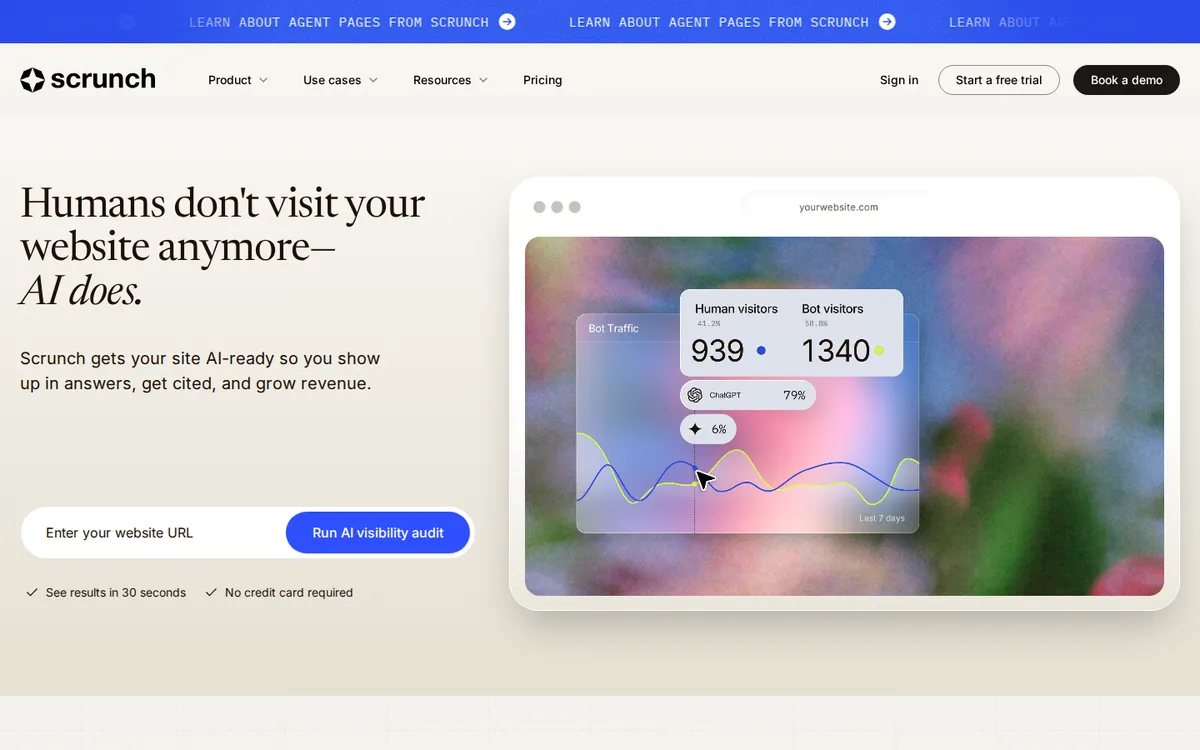
- Scrunch: Scrunch is the enterprise pick for a company that needs one platform across every LLM (large language model) and a vendor with a named enterprise customer roster.
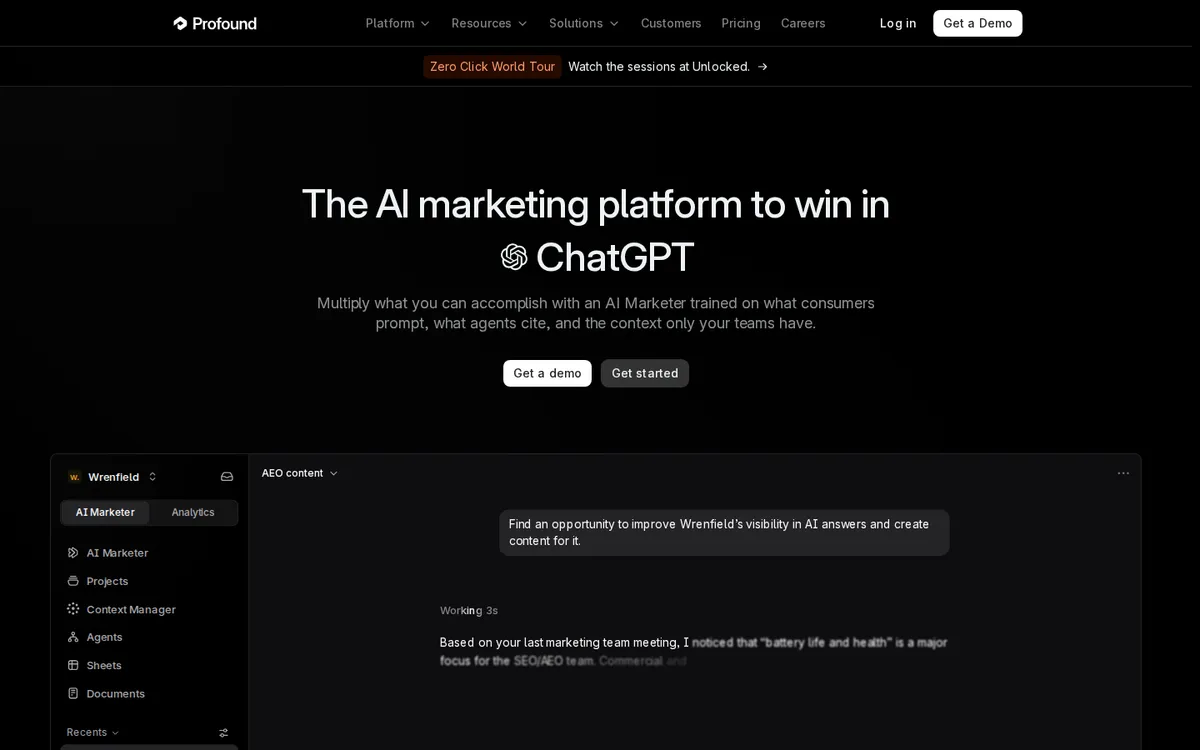
- Profound: Profound is the enterprise pick for a brand that wants data on what people ask AI and on how AI bots cite its pages.



Free AI Product Marketing Playbook to advance your career
Thanks. Your copy of the playbook is ready.
Download the PDFWhat is an AI visibility tool?
An AI visibility tool is software that asks AI assistants such as ChatGPT, Google AI Overviews, Perplexity and Gemini the questions your buyers ask. The tool then records whether each answer mentions your brand, which of your pages the answer cites, and how the answer describes you against competitors.
AI visibility, also called AI search visibility or LLM visibility, is the share of those AI answers in which your brand appears. A rank tracker shows your position in a list of Google results, while an AI visibility tool shows your presence inside the written answer itself.
What should an AI visibility tool track?
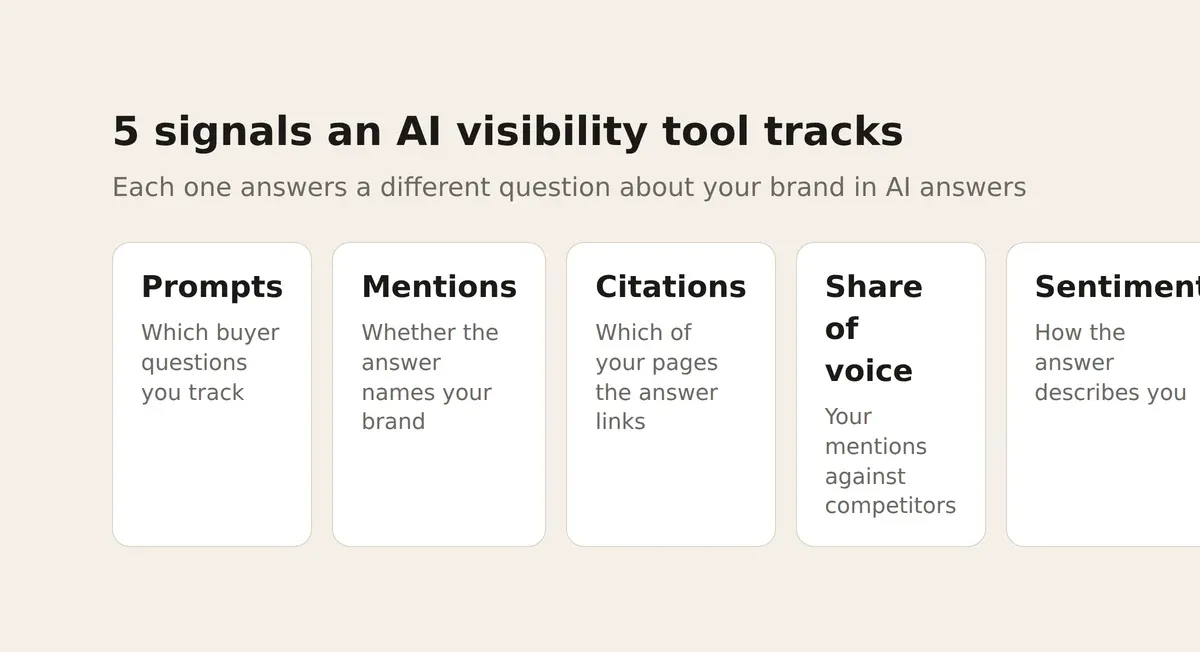
An AI visibility tool should track 5 signals for every prompt: the prompt itself, brand mentions, citations, share of voice and sentiment. A tool that reports only mentions tells you that you appear, but not why, where or how you compare.
- Prompts: Prompts are the buyer questions the tool sends to each AI engine on a schedule, such as "which AI visibility tool should a small team use", and a good tool lets you edit that list.
- Mentions: Mentions count how often an AI answer names your brand, and Ahrefs Brand Radar defines the metric as how often your brand name appears in AI answer text.
- Citations: Citations are the pages an AI answer links as its sources, and SE Ranking tracks both the brand mentions and the links your prompts trigger.[3]
- Share of voice: Share of voice is your count of mentions as a share of all brand mentions for the same prompts, which is how you benchmark competitors.
- Sentiment: Sentiment is how the AI answer characterizes your brand, and HubSpot gives sentiment the most weight in its grade because recognition alone does not win the recommendation.[2]
A sixth signal, AI bot traffic, matters once you publish for AI answers: Profound's agent analytics show how AI bots view, cite and refer to your pages. Server logs give the same signal for free if your team can read them.
Which are the best AI visibility tools?
The best AI visibility tools are HubSpot AI Search Grader for a free first check, SE Ranking and Otterly.AI for a small team's first tracker, and Peec AI and Rankscale for a team that benchmarks competitors weekly. Semrush AI Visibility and Ahrefs Brand Radar suit teams already on those suites, and Scrunch and Profound suit enterprise programs.
Each pick below gives what the tool does, where you can use it, and the verified public proof from the vendor's own page.
1. Best AI visibility tool for a free first check: HubSpot AI Search Grader
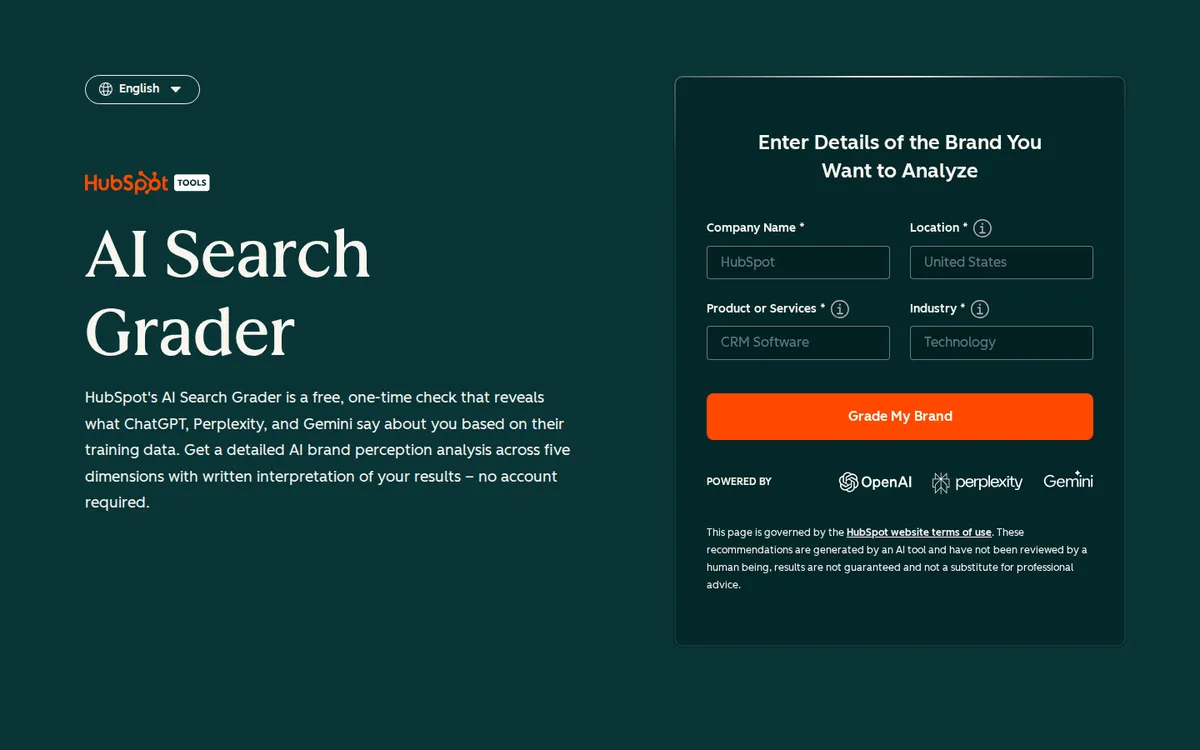
- What it does: HubSpot AI Search Grader runs a one-time check of how AI engines describe your brand and returns a grade in which sentiment carries the most weight.
- Where to use it: You can use HubSpot AI Search Grader to get a first read on your brand in AI answers before you pay for any tracker, and to repeat that read after each big content change.
- Why it's the best: HubSpot AI Search Grader costs nothing to run and analyzes 3 engines, GPT-5.4 mini from OpenAI, Perplexity and Gemini from Google, which makes it the lowest-risk start on this list (Nov 2026).[2]
2. Best AI visibility tool inside an SEO suite for small teams: SE Ranking
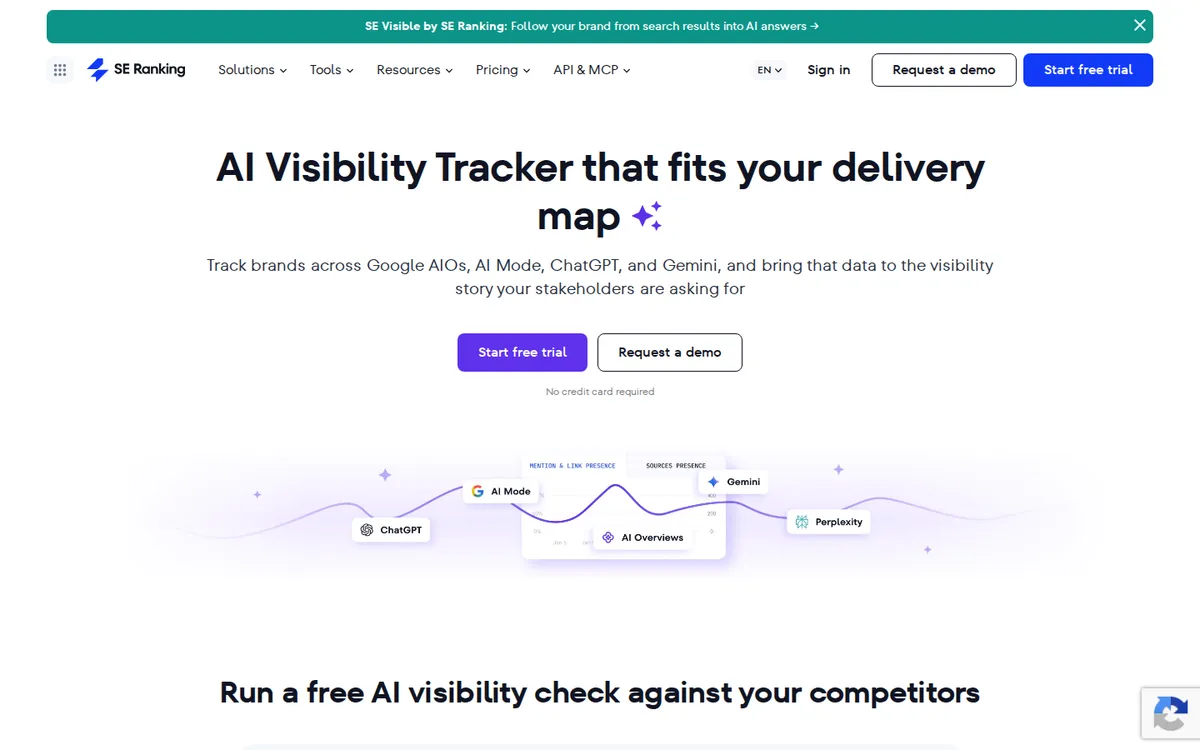
- What it does: SE Ranking adds an AI visibility tracker to its SEO platform, so one account holds your SEO data and your AI answer tracking.
- Where to use it: You can use SE Ranking to track your brand's mentions and cited links across Google AI Overviews, AI Mode, ChatGPT and Gemini from the same prompt list your SEO team already manages.
- Why it's the best: SE Ranking tracks brands across 4 engines, Google AI Overviews, AI Mode, ChatGPT and Gemini, and offers a free 14-day trial, so a small team can test the tracker on its own prompts before paying (Nov 2026).[3]
3. Best AI visibility tool for wide engine coverage: Otterly.AI
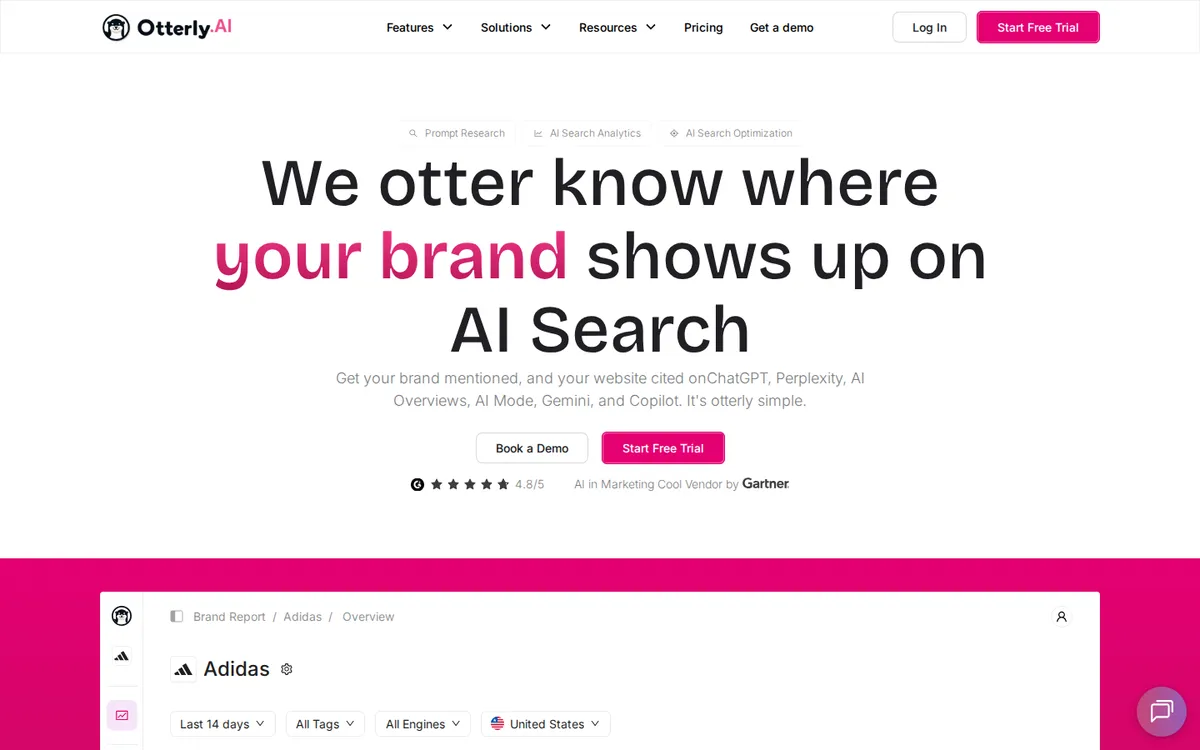
- What it does: Otterly.AI monitors your brand mentions and website citations across the major AI engines from one prompt list and reports which pages each engine cites.
- Where to use it: You can use Otterly.AI to watch one set of buyer prompts across 6 engines at once, which suits a team whose buyers use Copilot or AI Mode as much as ChatGPT.
- Why it's the best: Otterly.AI covers 6 engines, ChatGPT, Perplexity, AI Overviews, AI Mode, Gemini and Copilot, the widest named list among the self-serve trackers here apart from Rankscale (Nov 2026).[4]
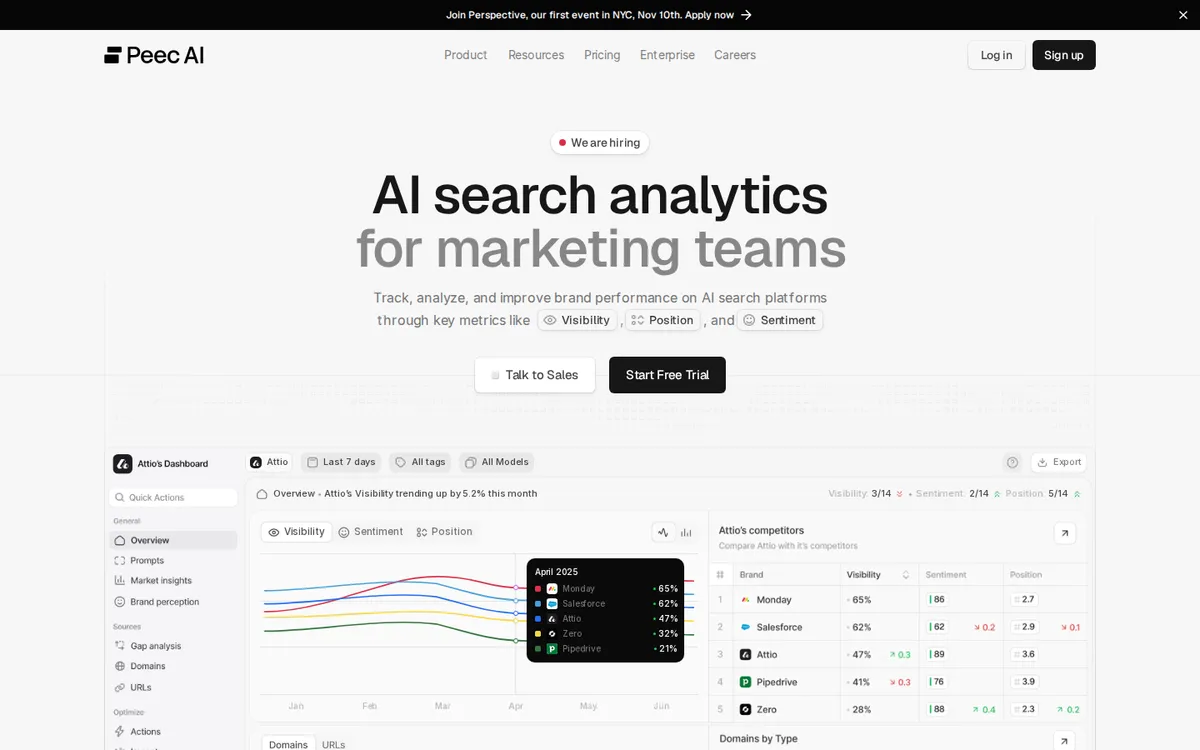
4. Best AI visibility tool for competitor benchmarking: Peec AI
- What it does: Peec AI tracks your visibility in AI search, benchmarks it against competitors, and exports the data as .csv files for your own reports.
- Where to use it: You can use Peec AI to build a weekly share-of-voice report that shows your brand against 3 or 4 competitors on the same prompts, then share it with leadership from your own reporting tool.
- Why it's the best: Peec AI says 4,000+ brands and agencies trust it, the largest customer count among the dedicated trackers on this list, and its scope covers visibility tracking, competitor benchmarks and .csv exports for your own reports (Nov 2026).[1]
5. Best AI visibility tool for the widest engine list: Rankscale
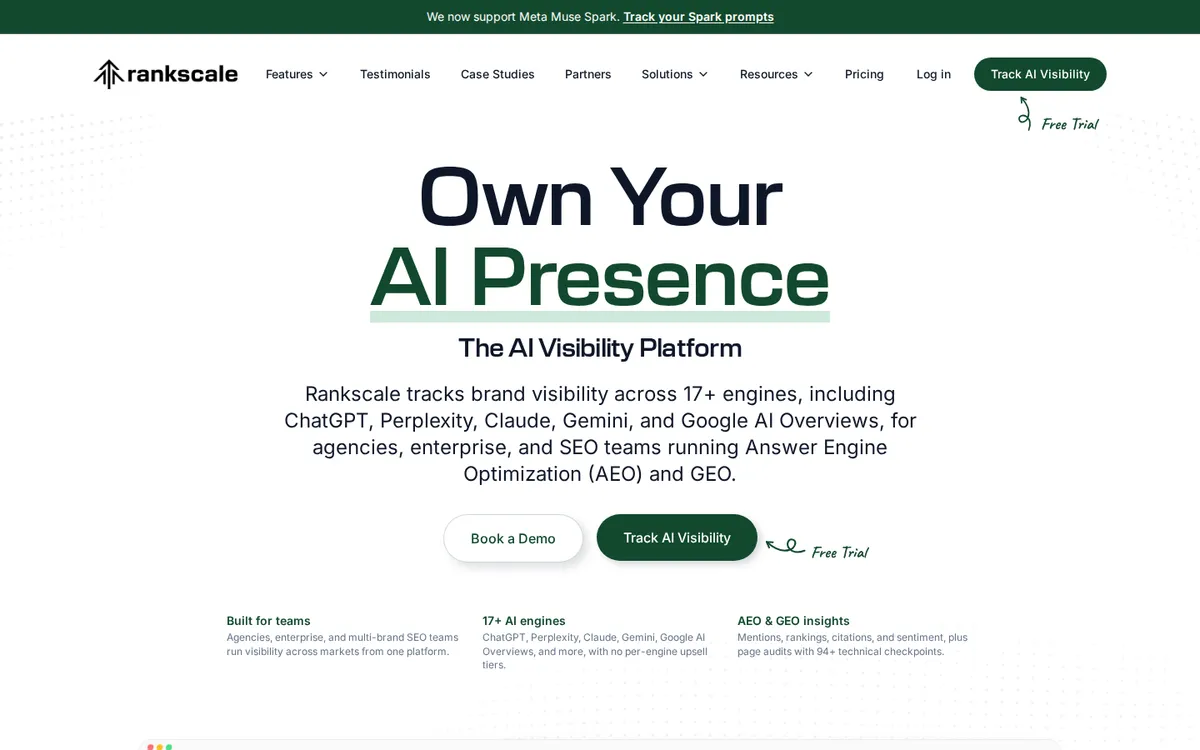
- What it does: Rankscale tracks brand visibility across 17+ AI engines, including ChatGPT, Perplexity, Claude, Gemini and Google AI Overviews, on self-serve plans with a trial on request.
- Where to use it: You can use Rankscale when your buyers spread across many assistants, including Claude, and you want one dashboard that covers engines the other trackers skip.
- Why it's the best: Rankscale covers 17+ engines, the widest engine list on this page, and says 1,000+ active users already use it (Nov 2026).[5]
6. Best AI visibility tool for Semrush users: Semrush AI Visibility
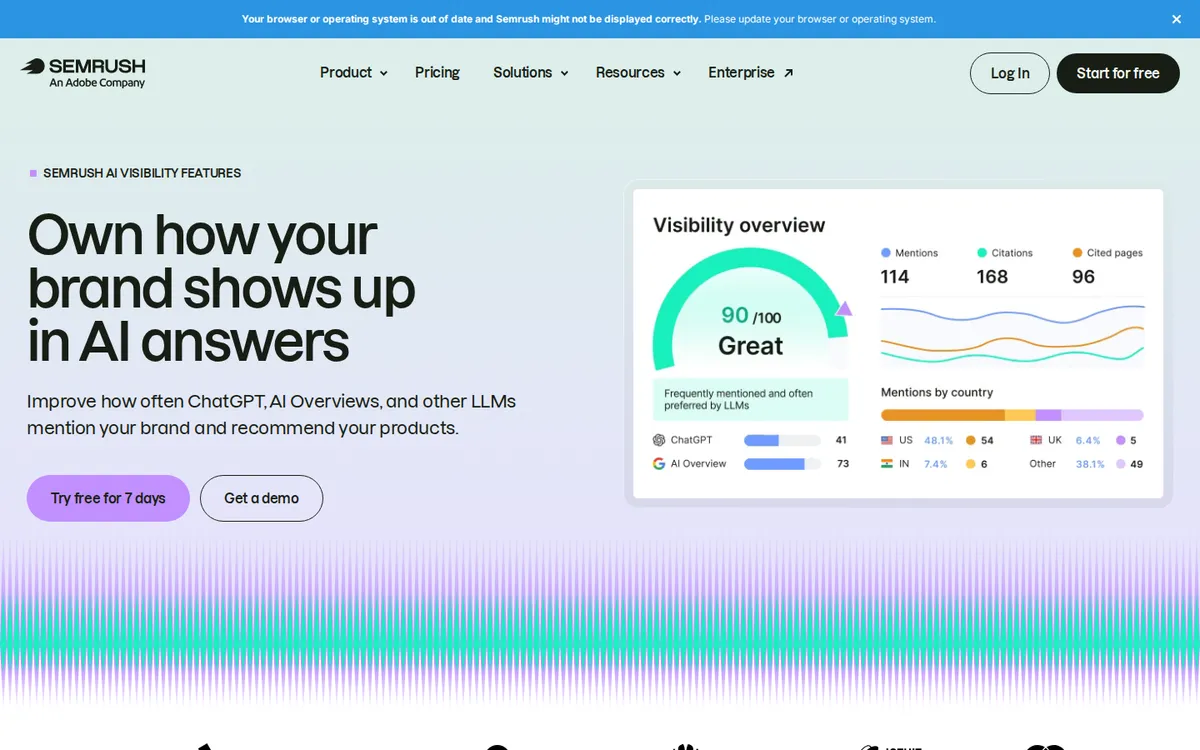
- What it does: Semrush AI Visibility reports how often a brand appears in AI-generated answers across platforms, regions and topics, next to the keyword and backlink data Semrush already holds.
- Where to use it: You can use Semrush AI Visibility to add AI answer tracking to an existing Semrush workflow, so your SEO reports and AI visibility reports come from one source of truth.
- Why it's the best: Semrush AI Visibility names 3 engines on its features page, ChatGPT, Gemini and Google's AI Overviews, and reports visibility by platform, region and topic, so a Semrush team adds AI tracking to the data it already pays for (Nov 2026).[6]
7. Best AI visibility tool for research at scale: Ahrefs Brand Radar
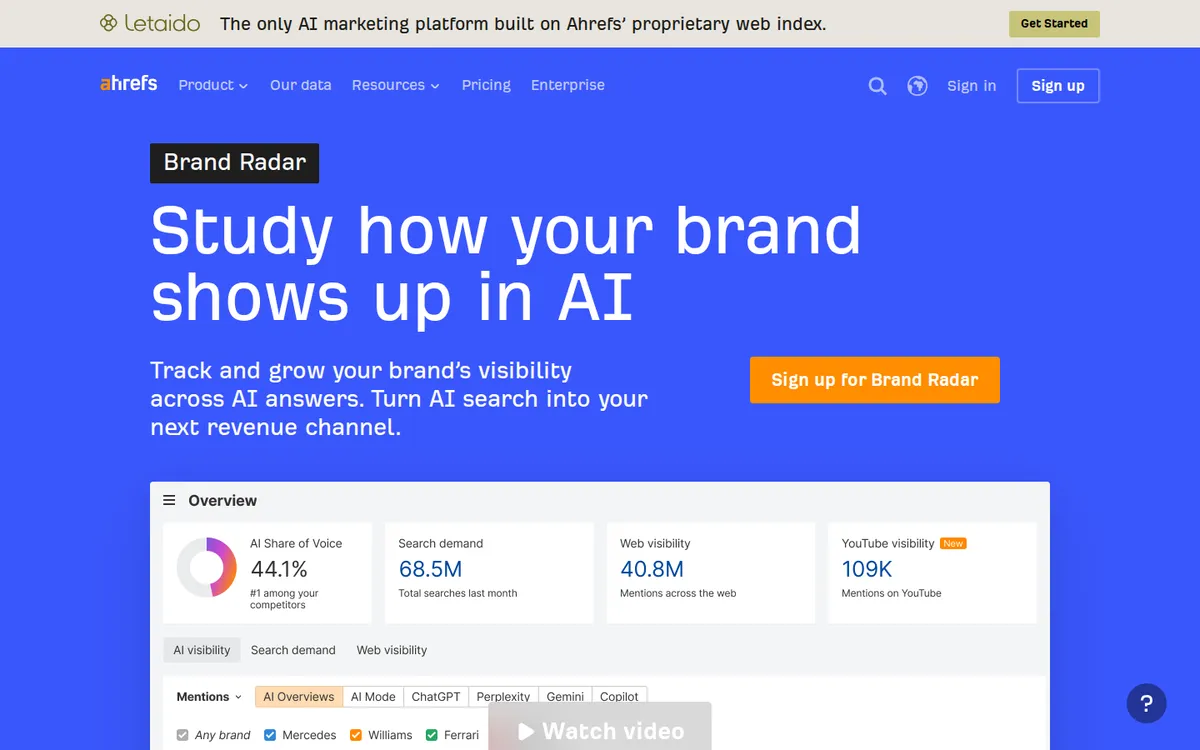
- What it does: Ahrefs Brand Radar measures AI visibility from an index of search-backed prompts, so you can study any brand or category at scale.
- Where to use it: You can use Ahrefs Brand Radar to compare your brand's mentions against a whole category, or to find the prompts where a competitor appears and you do not.
- Why it's the best: Ahrefs Brand Radar runs 525 million+ search-backed prompts through AI Overviews, AI Mode, ChatGPT, Perplexity, Gemini and Copilot, the largest prompt index any vendor on this list states (Nov 2026).[7]
8. Best AI visibility tool for enterprise teams: Scrunch
- What it does: Scrunch tracks brand presence, performance and position across every LLM for enterprise companies and the agencies that serve them.
- Where to use it: You can use Scrunch when several brands, regions or agencies need the same AI visibility data under one enterprise account.
- Why it's the best: Scrunch says 500+ companies and agencies trust it, including Lenovo, Skims, Crunchbase and Penn State, which is the strongest named enterprise roster on this list (Nov 2026).[8]
9. Best AI visibility tool for conversation and bot data: Profound
- What it does: Profound analyzes real user conversations with AI to show what people ask, and its agent analytics show how AI bots view, cite and refer to your pages.
- Where to use it: You can use Profound to decide what to publish next from the questions people ask AI, then confirm from bot analytics that AI crawlers cite the new pages.
- Why it's the best: Profound combines 2 data sets no other pick here pairs, billions of real user conversations and AI bot analytics, so it covers the demand side and the crawl side of AI visibility in one platform (Nov 2026).[9]
How much do AI visibility tools cost?
AI visibility tools fall into 3 price bands: free one-time checks, self-serve plans, and enterprise platforms sold to large teams. Vendors change plans often, so check each pricing page before you compare.
- Free checks: HubSpot AI Search Grader costs nothing and needs no account, and SE Ranking gives a free 14-day trial of its tracker, so the first week of AI visibility work costs 0.
- Self-serve plans: Otterly.AI, Peec AI, Rankscale, SE Ranking, Semrush and Ahrefs sell self-serve plans, so compare the prompt, engine and competitor limits each pricing page lists.
- Enterprise platforms: Scrunch and Profound are built for enterprise teams, so plan a sales conversation and a procurement review rather than a card swipe.
How do you pick an AI visibility tool?
To pick an AI visibility tool for your team, follow these 6 steps:
- Write the 20 questions your buyers ask before they shortlist a vendor, in their words.
- Run 5 of those questions by hand in ChatGPT, Perplexity and Google AI Mode, and note who gets mentioned.
- Run your brand through HubSpot AI Search Grader once to get a baseline score.
- Write down the engines your customers use, then drop every tool that misses one of them.
- Start a trial on 1 tracker, load the 20 questions and 3 competitors, and check the cited-page report after 1 week.
- Pick the tool whose cited-page report changed what your content team worked on that week.
The last step is the real test, because a tracker only earns its fee when its reports change which pages you write or rewrite.
What mistakes do teams make with AI visibility tracking?
The most common mistake with AI visibility tracking is tracking brand-name prompts, which you already win, instead of the category questions where buyers meet competitors. The other 4 mistakes below waste the subscription too.
- Tracking too few prompts: AI answers vary by wording, so 5 prompts give a noisy score, while at least 20 prompts per product line give a trend you can act on.
- Ignoring citations: A mention without a citation sends no visitor, so the cited-page report shows which content earns traffic from AI answers better than the mention count does.
- Reading one week in isolation: AI engines update models and sources often, so compare 4-week averages, not day-to-day moves.
- Skipping sentiment: An answer that names your brand as the expensive option is a mention and a problem, so read how the engine describes you, not only whether it does.
- Paying for engines nobody uses: A 17-engine dashboard helps only if your buyers use those engines, so match the engine coverage to the assistants your customers use.
Your first step to measure AI visibility
Write your 20 buyer questions today and run your brand through HubSpot AI Search Grader before you open any pricing page, because the free grade tells you which of the best AI visibility tools you need next. Once the cited-page report shows gaps, the content work starts, and my guide to the best Claude skills for marketing and SEO covers the skills that draft and audit that content.
A team that measures AI visibility weekly knows within a month which pages AI engines cite and which questions it loses to competitors.
Resources and References Used for Research
- [1] Peec AI - AI Search Platform for Marketing Teams - Peec AI (Nov 2026)
- [2] AI Search Grader: Free One-Time AEO Brand Check, No Account Required - HubSpot (Nov 2026)
- [3] AI Search Visibility Tool: Optimize for AI Search - SE Ranking (Nov 2026)
- [4] AI Search Monitoring Tool: Track ChatGPT, Perplexity & Google AIO - OtterlyAI (Nov 2026)
- [5] AI Visibility Platform for ChatGPT, Perplexity & AI Overviews | Rankscale - Rankscale (Nov 2026)
- [6] Semrush AI visibility features - Semrush (Nov 2026)
- [7] Ahrefs Brand Radar: Study your brand's AI visibility - Ahrefs (Nov 2026)
- [8] Scrunch | The AI Customer Experience Platform | AI search visibility & insights - Scrunch (Nov 2026)
- [9] Profound | The AI Platform to Power Your Marketing - Profound (Nov 2026)
AI Visibility Tools FAQs
Are there free AI visibility tools?
Yes, HubSpot's AI Search Grader runs a free one-time check of your brand in GPT-5.4 mini, Perplexity and Gemini, with no account needed. SE Ranking also offers a free 14-day trial of its AI visibility tracker. A free check tells you where you stand today, while a paid tracker follows the same prompts week after week.
What is the difference between AI visibility and SEO rank tracking?
AI visibility measures whether an AI answer mentions or cites your brand, while SEO rank tracking measures your position in a list of Google results. A rank tracker checks one keyword against 10 blue links. An AI visibility tool checks a full question against a written answer from ChatGPT, Google AI Overviews, Perplexity or Gemini, and records mentions, citations and sentiment.
Which AI engines should an AI visibility tool cover?
An AI visibility tool should cover at least ChatGPT, Google AI Overviews and AI Mode, Perplexity and Gemini, because those are the engines most buyers use for research. Otterly.AI and Ahrefs Brand Radar add Microsoft Copilot, and Rankscale covers 17+ engines including Claude. Check which engines your own customers use before you pay for the widest list.
How often should you check AI visibility?
Check AI visibility weekly for your core prompts and monthly for the full list, because AI answers change with every model update and every new source the engine finds. A tracker such as Peec AI or Otterly.AI runs the prompts for you on a schedule. A one-time grader such as HubSpot's gives a snapshot, so repeat it after each major content change.
Can Semrush or Ahrefs track AI visibility?
Yes, both suites now track AI visibility. Semrush AI Visibility reports how often a brand appears in AI-generated answers across platforms, regions and topics, and Ahrefs Brand Radar measures AI visibility by running 525 million+ search-backed prompts through AI Overviews, AI Mode, ChatGPT, Perplexity, Gemini and Copilot. A team already paying for either suite can add AI tracking without a new vendor.
Do AI visibility tools show which pages AI cites?
Yes, most AI visibility tools list the pages an AI answer cites for each prompt, both yours and your competitors'. SE Ranking monitors brand mentions and links triggered by your prompts, and Profound's agent analytics show how AI bots view, cite and refer to your pages. The cited-page list is the most useful report, because it tells you which content to improve or copy.